Buying Guide of Paeonolum
Aug 21, 2025
Perhaps you're feeling a bit overwhelmed or uncertain while trying to choose the right Paeonolum, unsure where to start or what to trust. We've all been there. That's why we've put together this practical buying guide: to cut through the confusion and offer clarity. Whether you're comparing purity levels, sourcing standards, or formulation types, we'll help you understand what matters when selecting high-quality paeonol.
What should I look for to ensure the quality of paeonol?
Certificate of Analysis (CoA)
This is the single most important document for verifying quality. A proper CoA should include:
A. Product Name and Batch/Lot Number: The CoA must be specific to your purchase batch.
B. Test Parameters and Results:
a. Purity (%): This is the most critical factor. Look for high purity levels, typically >98% or >99% for common use. The CoA should state the method used (e.g., HPLC).
b. Identification Test: Confirmation that the substance is indeed paeonol (e.g., via FTIR, NMR, or HPLC retention time matching a reference standard).
C. Limits of Impurities:
a. Heavy Metals: Levels of lead (Pb), arsenic (As), cadmium (Cd), and mercury (Hg) must be tested and fall within accepted limits (e.g., USP <232> or ICH Q3D guidelines).
b. Residual Solvents: If solvents are used in the extraction or purification process, their residues must be quantified and meet safety guidelines (USP <467> or ICH Q3C).
c. Microbiological Tests: Total aerobic microbial count, total yeast and mold count, and absence of specific pathogens like E. coli and Salmonella.
D. Test Methods: The CoA should reference the standardized analytical methods used (e.g., "USP <61>" for microbial enumeration).
E. Date of Analysis and Validity: The CoA should be recent and relevant to the current batch.
Physical and Chemical Characteristics
a. Appearance: High-purity paeonol typically appears as a white to off-white crystalline powder. A yellow or brown color suggests oxidation, age, or a low level of purity. It should be a fine, homogeneous powder without signs of clumping or moisture.
b. Solubility: Paeonol is sparingly soluble in water but freely soluble in organic solvents like ethanol, methanol, and DMSO.
Packaging and Labeling
A. Packaging: The powder should be sealed in a durable, airtight container (e.g., a glass bottle, a sealed plastic vial inside a bag) with a desiccant pack to prevent moisture absorption. It should be packed securely to prevent damage during shipping.
B. Labeling: The container must have a clear, professional label stating:
a. Product name (Paeonol)
b. Chemical Abstract Service (CAS) Number (552-41-0)
c. Batch or Lot number
d. Purity percentage
e. Date of manufacture or expiration date
f. Supplier name

Are there any drug interactions with paeonol?
Yes, paeonol has the potential to interact with pharmaceutical drugs by altering how they are absorbed, metabolized, or how they work in the body.
Interactions with Blood Thinners (Anticoagulants and Antiplatelets)
a. This is one of the most significant potential interaction categories.
b. Drugs Affected: Warfarin (Coumadin), Clopidogrel (Plavix), Aspirin, and so on.
c. Mechanism of Interaction: Paeonol has demonstrated antiplatelet and anticoagulant properties in several studies. It is believed to inhibit platelet aggregation (clumping), which is a vital part of the blood clotting process. It may also have mild anticoagulant effects.
Interactions with Drugs Metabolized by Liver Enzymes (Cytochrome P450)
a. The liver uses a family of enzymes, primarily Cytochrome P450 (CYP), to break down medications. Paeonol can influence the activity of these enzymes.
b. Drugs Affected: This is a very broad category. Examples include statins (e.g., atorvastatin, simvastatin) for cholesterol, calcium channel blockers (e.g., amlodipine, verapamil) for blood pressure, benzodiazepines (e.g., diazepam) for anxiety and sleep, many antidepressants and antipsychotics, and immunosuppressants (e.g., cyclosporine).
c. Mechanism of Interaction: Research indicates that paeonol can both inhibit and induce certain CYP enzymes, depending on the context and dosage. For example, some studies show it can inhibit CYP2C9 and CYP2D6, while others suggest it may induce CYP1A2 and CYP2B1.
Interactions with Blood Pressure Medications (Antihypertensives)
a. Drugs Affected: ACE inhibitors (e.g., Lisinopril, Enalapril), ARBs (e.g., Losartan, Valsartan), beta-blockers (e.g., Metoprolol, Atenolol), and diuretics (e.g., Hydrochlorothiazide).
b. Mechanism of Interaction: Paeonol has been studied for its vasodilatory and hypotensive (blood pressure-lowering) effects. It acts through various mechanisms, including promoting the release of nitric oxide, which relaxes blood vessels.
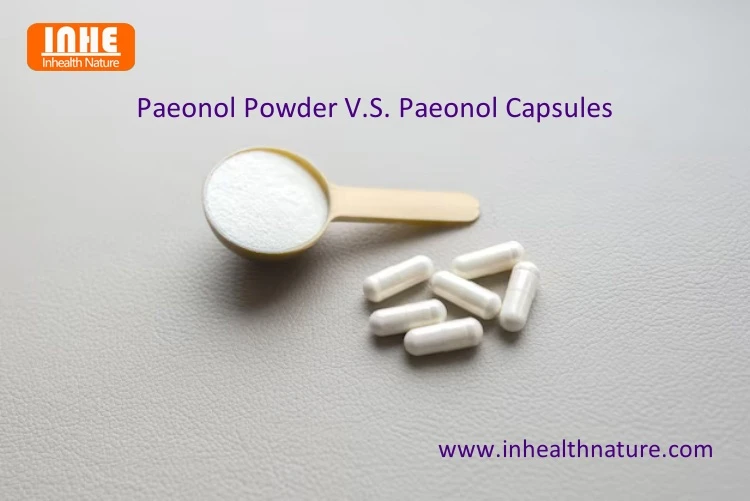
What is the best dosage form of paeonol? Powder or capsules?
The best dosage form for paeonol is not a matter of superiority but of context. The optimal choice depends entirely on the user's intended purpose, technical skill, and risk tolerance.
Paeonol Powder
A. Primary Use: This form is intended almost exclusively for industrial, research, and manufacturing applications.
B. Product Features:
a. Cost Efficiency: Buying bulk powder can be cheaper per gram than buying pre-encapsulated products, as you avoid the cost of the encapsulation process and packaging.
b. Formulation Flexibility: A researcher or manufacturer can dissolve the pure powder into solvents for experiments (e.g., cell culture, animal studies) or incorporate it into custom formulations like creams, gels, or other delivery systems where a capsule is not suitable.
c. No Additives: The powder is pure paeonol, free from excipients like fillers or flow agents that are necessary in capsules.
Paeonol Capsules
A. Primary Use: This form is designed for oral consumption, typically as a dietary supplement.
B. Product Features:
a. Precise and Consistent Dosing: Each capsule contains a pre-measured amount of paeonol, ensuring dose consistency and eliminating the guesswork and extreme danger of trying to measure it yourself.
b. Ease of Use and Convenience: Capsules are portable, require no preparation, and are easy to swallow. They eliminate the mess and hassle of handling a fine powder.
c. Improved Tolerability: The capsule shell encapsulates the powder, masking its taste and smell and preventing it from irritating the mouth or throat.
d. Formulation for Absorption: Reputable manufacturers often include other ingredients to enhance bioavailability. A capsule might contain:
A Carrier Agent: Such as a phospholipid or a medium-chain triglyceride (MCT) oil powder to improve solubility and absorption.
Bioavailability Enhancers: Compounds like black pepper extract (piperine) can inhibit metabolic enzymes in the gut and liver, potentially allowing more paeonol to enter the bloodstream.
What is the typical onset of effects?
Key Factors Influencing the Onset of Action
The time it takes to feel any effect from paeonol is not a single number. It depends on:
A. Dosage Form and Route of Administration: This is the most significant factor.
a. Oral Ingestion (Capsules/Powder): This is the slowest route. The compound must survive stomach acid, be dissolved in the gut, pass through the intestinal wall, and then be transported to the liver before even entering the systemic circulation (a process called "first-pass metabolism").
b. Topical Application (Creams/Ointments): Effects can be much more localized and faster, as the compound is delivered directly to the target area (e.g., skin or underlying tissue), bypassing the digestive system and liver.
B. Formulation and Bioavailability: Pure paeonol has very low water solubility, which limits its absorption from the gut. Formulations that improve solubility (e.g., using lipid carriers, nanoparticles, or phospholipid complexes) can significantly enhance both the speed (onset) and extent (strength) of its effects.
C. Individual Factors: A person's unique metabolism, gut health, age, weight, and genetics can all influence how quickly and efficiently paeonol is absorbed and becomes active.
Estimated Onset Times Based on Route
a. Oral Administration (e.g., Capsules): For systemic effects (e.g., anti-inflammatory, analgesic), if absorption occurs, the onset would likely be between 45 minutes and 2 hours after ingestion. This is a typical timeframe for many orally administered compounds to begin appearing in the bloodstream in significant quantities.
b. Topical Administration (e.g., Creams/Gels): Effects on the local area (e.g., skin, joints) could begin more quickly, potentially within 30 minutes to 1 hour. This is because the compound diffuses directly into the tissues it is applied to, avoiding the delays of the digestive system.
What's the difference between paeonol and paeoniflorin?
Natural Occurrence and Source within the Plant
While both are from peony, they are found in different parts and concentrations.
A. Paeonol:
a. Primary Source: The root bark of Tree Peony (Paeonia suffruticosa).
b. Secondary Sources: It is also found in the Chinese herb Cynanchum paniculatum (Xu Chang Qing) and is a major component of the volatile oil of peony roots.
B. Paeoniflorin:
a. Primary Source: The root of the White Peony (Paeonia lactiflora). It is considered the most abundant and characteristic active ingredient of this herb.
b. Concentration: It can constitute up to 5% or more of the dry weight of White Peony root.
Key Activities
Both compounds are highly active but through often divergent mechanisms.
A. Paeonol:
a. Anti-inflammatory: Strongly inhibits pro-inflammatory cytokines (e.g., TNF-α, IL-6) and enzymes like COX-2 and iNOS.
b. Antioxidant: Effectively scavenges free radicals and reduces oxidative stress.
c. Cardiovascular Protection: Shows vasodilatory effects (lowers blood pressure), protects against atherosclerosis, and reduces myocardial ischemia.
d. Mechanism Summary: Its actions are often linked to modulating the NF-κB and MAPK signaling pathways, which are central regulators of inflammation and cell survival.
B. Paeoniflorin:
a. Neuroprotective: Its most renowned effect. It protects neurons, improves learning and memory, and has demonstrated benefits in models of Alzheimer's, Parkinson's, cerebral ischemia, and depression. It modulates neurotransmitters like GABA and glutamate.
b. Antispasmodic & Hepatoprotective: A classic use in TCM is to "soothe the liver" and calm muscle spasms or cramps. It protects liver cells from damage.
c. Immunomodulation: Unlike paeonol's direct anti-inflammatory action, paeoniflorin has a more complex modulating effect on the immune system. It can calm overactive immune responses (e.g., in rheumatoid arthritis) but is not a simple suppressor.
d. Pain Modulation (Unique): It is known to have an analgesic effect, particularly for neuropathic and inflammatory pain, but it is not opioid-mediated and does not cause tolerance, making it a subject of interest for novel pain therapies.
e. Mechanism Summary: It frequently acts by modulating calcium channels, the cholinergic system, and the HPA (hypothalamic-pituitary-adrenal) axis, which is involved in stress response.
Reach out to us at april@inhealthnature.com to explore how we can collaborate to promote effective applications of Paeonolum.