Agar Powder vs. Gelatin Powder: Which One is Suitable for You?
Jun 16, 2026
Agar Agar Powder Wholesale is currently one of the most searched ingredients in the plant-based revolution. Whether you are formulating a next-generation vegan gummy or a high-end aspic, the choice between Agar Agar and Gelatin is a critical decision that affects cost, texture, shelf-life, and market positioning.
Agar Agar Powder has transformed from a once-niche Asian ingredient into a globally essential one, driven by the rise of vegetarianism, Halal requirements, and clean-label trends, overtaking Gelatin, which had been the industry standard for gelation for decades.
In this guide, we will dissect these two hydrocolloids across multiple critical dimensions, including dietary suitability, thermal dynamics, texture, gel strength, preparation methods, applications, and functional limitations. We will also explore regional demand patterns and address common FAQs regarding product applications in the market.
dietary suitability
The most obvious distinction lies in the origin, and for modern consumers, this is often the deciding factor.
Gelatin PowderGelatin is derived from animal collagen, typically bovine hides or porcine skin. It is a protein obtained by partial hydrolysis of collagen. Consequently, it is strictly not suitable for vegetarians, vegans, or those observing Kosher/Halal (unless specific, expensive certified bovine or fish gelatin is sourced). Even with certified versions, cross-contamination risks during manufacturing remain a concern for strict adherents.
Agar Agar PowderAgar is a polysaccharide extracted from red seaweed (primarily Gracilaria, Gelidium, or Pterocladia species). It is naturally 100% plant-based, vegan, and vegetarian. No animal products are involved at any stage of production.
For B2B buyers looking for Agar Agar Powder, certification is key. Inhealth Nature provides Agar that is naturally compliant with Halal, Kosher, and Vegan standards without the need for chemical modification. Our production facilities follow strict GMP protocols, ensuring every batch meets the highest purity thresholds required for international religious certifications. This simplifies your labeling, turning a complex chemical name into a clean "Seaweed Extract" that appeals directly to the conscious consumer.
thermal dynamics
The specific differences in the thermodynamics between gelatin powder and agar powder are as follows:
| Property | Gelatin Powder | Agar Agar Powder |
| Melting Point | 35°C (95°F), melts in the mouth | 85-95°C (185-203°F) |
| Setting Point | 15°C (59°F), requires refrigeration | 32-40°C (90-104°F), sets at room temperature |
| Thermoreversibility | Yes, remelts easily | Yes, but requires high heat (>85°C) |
| Hysteresis | Narrow (20°C gap) | Wide (45-55°C gap) |
a. Gelatin melts at body temperature, giving it that signature "melt-in-the-mouth" sensation, ideal for gummy candies and marshmallows. However, this also means gelatin-based products are heat-sensitive and cannot be shipped to warm climates without cold chain logistics.
b. Agar Agar possesses remarkable thermal hysteresis. It requires high temperatures to melt, but stays gelled at warm ambient conditions. This makes it essential for products distributed in tropical regions (e.g., Southeast Asia, the Middle East, and parts of Africa and Latin America). The downside? Agar-based products do not "melt" on the tongue; they remain firm and require chewing or breaking.
Market InsightIn Japan and South Korea, where ambient temperatures vary drastically from cold winters to humid summers, Agar Agar Powder is preferred for traditional Wagashi and savory gels because it remains stable on the shelf without refrigeration. In contrast, gelatin is reserved for refrigerated desserts only.
texture and mouthful
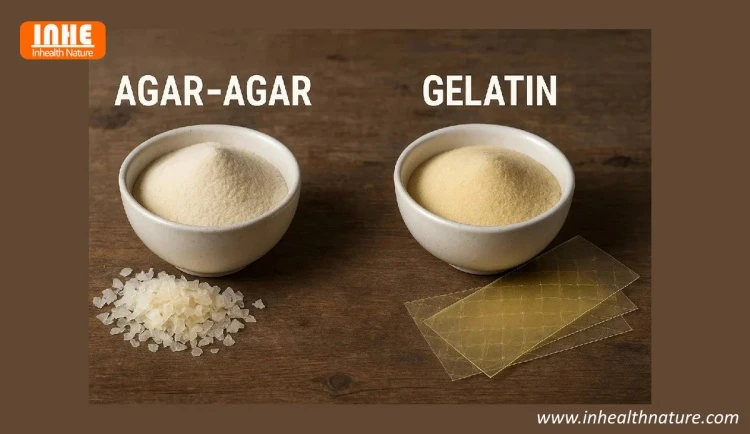
Gelatin produces an elastic, thermoreversible, and soft gel. When you bite into a high-quality gummy bear, the "snap" followed by a chewy, yielding texture comes from gelatin. It is also thermoreversible, meaning you can reheat and reset it multiple times, which is useful for R&D prototyping and reducing production waste.
B. Agar Agar: Firm and BrittleAgar produces a firm, brittle, and rigid gel. It does not "chew" like gelatin; it breaks or crumbles under pressure. If too much Agar is used (above 1.5% of liquid weight), the product feels hard, sandy, or chalky on the palate. This is why precision in dosage is critical with Agar.
C. Pro Tip for FormulatorsMany high-end manufacturers are now blending Agar with other hydrocolloids to mimic the elasticity of gelatin while keeping the plant-based label. Common synergists include:
a. Locust Bean Gum (LBG): Increases elasticity and reduces syneresis (water weeping).
b. Konjac glucomannan: Creates a chewy, gelatin-like texture.
c. Xanthan gum: Improves suspension and mouthfeel.
Why Mesh Size Matters for TextureThe physical form of agar directly impacts the ease of hydration and final gel quality. Coarse or inconsistent particles may fail to fully dissolve under standard production conditions, leaving undissolved specks that create a gritty or chalky sensation, one of the key texture flaws formulators seek to avoid when replacing gelatin. (Note: Even with complete dissolution, excessive agar concentration, typically above 1.0-1.5%, can also cause a powdery or sandy mouthfeel; mesh size alone does not solve overdosing issues.)
Inhealth Nature supplies 80 mesh agar powder as our standard grade. This particle size is specifically selected to balance rapid hydration with smooth dispersion. Unlike finer powders that tend to clump or ultra-coarse granules that require extended boiling, our 80 mesh agar dissolves cleanly and completely under standard production conditions, provided the recommended dosage range is followed. The result is a uniform, grit-free gel, free from undissolved particles, allowing you to achieve a clean, pleasant mouthfeel while maintaining a 100% plant-based label. For buyers sourcing Agar Agar Powder, this consistency eliminates texture-related rework caused by incomplete hydration and ensures every batch delivers the same smooth sensory experience.
Gel strength
In the industry, we measure Gelatin by "Bloom" (strength in grams). Agar uses "Gel Strength" (g/cm²), but they are not directly comparable. However, understanding potency is essential for formulation success.
Potency Comparisona. Agar is significantly more powerful. You typically need 0.2% to 0.5% Agar (in relation to total liquid weight) to set a firm gel.
b. Gelatin requires 2% to 10%, depending on the desired firmness and Bloom value.
Why Potency Matters for Productiona. The high potency of Agar means less storage space, lower shipping weight, and reduced handling costs per batch. For a 1,000-liter production run, you might use only 5 kg of Agar compared to 50 kg of gelatin. This difference impacts warehouse logistics, packaging materials, and freight expenses, particularly relevant for buyers sourcing Agar Powder across international borders.
b. Gel Strength Consistency Matters: Low-quality Agar can vary by ±30% in gel strength from batch to batch, forcing manufacturers to constantly adjust recipes. This variability increases production risk and quality control costs.
Our Agar Powder is tested for gel strength (800-1200 g/cm²) on every batch. We guarantee consistency within ±5% batch-to-batch, allowing you to set your production formulas once and run them reliably. For buyers seeking Agar Powder, this consistency translates directly to reduced waste and higher operational efficiency.
preparation Methods
The way you prepare each gelling agent differs significantly, impacting production line design and operator training.
A. Gelatin Preparationa. Blooming: Gelatin must be "bloomed" in cold water (1:5 ratio, gelatin to water) for 5-10 minutes to hydrate the protein.
b. Dissolution: The bloomed gel is then gently heated to 50-60°C (not boiling, which destroys gel strength).
c. Mixing: Dissolved gelatin is added to the main solution below 40°C to avoid clumping.
d. Time to set: 4-6 hours in refrigeration.
B. Agar Agar Preparationa. Direct hydration: Agar powder can be added directly to cold liquid and stirred to disperse (prevents clumping).
b. Boiling activation: The mixture must be brought to a full boil (95-100°C) and simmered for 3-5 minutes to hydrate the polysaccharide chains fully.
c. Setting: Once cooled to below 40°C, setting occurs within 30-60 minutes, no refrigeration required.
C. Key DifferenceGelatin is heat-sensitive and cannot be boiled. Agar requires boiling to activate. This makes Agar more energy-intensive during initial processing but eliminates the need for a refrigerated setting, saving energy downstream.
D. Production Tip for Large BatchesFor manufacturers using Agar Powder, pre-dispersing the powder in a small amount of cold liquid (sugar solution or water) before adding to the main kettle prevents fish-eyes (undissolved clumps). Inhealth Nature's agar powder reduces this risk compared with coarse-granular agar.

functional limitations
No ingredient is perfect, and knowing the limitations of each saves costly production failures.
Gelatin's Weaknessesa. Proteolytic enzyme sensitivity: Fresh pineapple, kiwi, papaya, mango, and figs contain bromelain, actinidin, or papain, enzymes that break down protein chains. If you add fresh or minimally processed versions of these fruits to gelatin, it will never set.
b. Heat sensitivity: Above 70°C, gelatin irreversibly loses gel strength.
c. Not suitable for vegans/vegetarians.
d. Solution for Gelatin: Use canned or cooked fruits (heat denatures the enzymes), or add the fruit after the gelatin has fully set.
Agar's Weaknessesa. High acid sensitivity: At pH below 4.0 (lemon, lime, passionfruit, vinegar-based systems), Agar undergoes acid hydrolysis over time. The gel strength will degrade significantly within 24-48 hours.
b. Syneresis (water weeping): If the gel is set too quickly or the concentration is too high, the polymer network contracts and squeezes out water, leaving a puddle on top of the gel.
c. No melt-in-mouth sensation.
d. Solution for Agar: For acidic applications, use a buffer (sodium citrate) to raise the pH to 4.5-5.0, or blend with LBG or carrageenan to improve stability. Inhealth Nature's technical team provides free formulation support for buyers purchasing AgarPowder. We help you troubleshoot acid stability and syneresis before you scale up.
The Synergy (Hybrid Systems)Recent studies (2024) show that combining Gelatin and Agar at specific ratios (e.g.,90:10 Gelatin: Agar) creates a composite coacervate with enhanced thermal stability and improved water retention. At pH 4.5-5.0, the electrostatic interaction between the negatively charged agar and positively charged gelatin (at low pH) improves gel strength beyond either ingredient alone. This is used in hybrid meat products (50% meat, 50% plant-based binders) to transition consumers to flexitarian diets.
typical applications
Typical applications of agar agar powder and gelatin powder are as follows:
| Application | Best Choice | Reason |
| Vegan gummy candies | Agar Agar Powder | Plant-based, heat-stable for shipping |
| Traditional gummy bears | Gelatin Powder | Elastic, melt-in-mouth texture |
| Fruit preserves & jams | Agar Agar Powder | Sets without high pectin/sugar |
| Meat aspics & terrines | Gelatin Powder | Clears well, protein compatibility |
| Plant-based dairy (yogurt, pudding) | Agar Agar Powder | Creamy texture, vegan label |
| Microbiological media (petri dishes) | Agar PowderAgarPowder | Inert, non-nutritive, high gel strength |
| Marshmallows & meringues | Gelatin Powder | Foam stabilization, elastic structure |
| Savory Asian desserts (Wagashi) | Agar Agar Powder | Traditional, heat-stable |
| Pharmaceutical capsules | Gelatin (or HPMC) Powder | Compatibility with active ingredients |
Regional market demand for Agar powder
When sourcing Agar Powder, geography dictates volume, specifications, and certification requirements.
A. North America (USA & Canada)
a. Demand drivers: Vegan gummy market growth (+24% CAGR 2023-2026), plant-based dairy alternatives, and clean label trends.
b. Certifications required: Organic (USDA/NOP), Non-GMO Project Verified, Kosher (OU or OK).
c. Regulatory status: GRAS by FDA. No usage restrictions on food.
B. Europe (EU-27 & UK)
a. Demand drivers: Stringent clean label regulations (rejection of E-numbers), sustainability mandates, and vegan lifestyle growth.
b. Certifications required: Organic (EU Organic Regulation), Halal, and Kosher.
c. Regulatory status: E406, permitted in all food categories with quantum satis (as needed) usage.
C. Middle East (UAE, KSA, Qatar, and Kuwait)
a. Demand drivers: Highest demand for Halal-certified gelling agents. Since standard gelatin is often porcine-based, Agar is the preferred, and sometimes only, option for mainstream confectionery and desserts.
b. Certifications required: Halal (ESMA or local body), plus Kosher for export to Israel.
c. Market nuance: High heat resistance required due to ambient storage and desert logistics.
D. Asia-Pacific (Japan, China, Thailand, and India)
a. Demand drivers: Traditional use in desserts (kanten in Japan, agal-agal in the Philippines), plus rapidly growing plant-based meat sector.
b. Certifications required: Local food safety standards (CFDA in China, FSSAI in India).
c. Market nuance: Japan consumes the highest per capita agar globally, also used in microbiological research.
Inhealth Nature ships globally with full documentation: COA, MSDS, Halal certificate, Kosher certificate, and batch-specific gel strength analysis. We understand regional requirements and help our wholesale buyers navigate import regulations.
FAQs
Q1: Can I substitute Agar Powder 1:1 for Gelatin?
A: No. If a recipe calls for 1 tablespoon of Gelatin, you need approximately 1 teaspoon of Agar powder (use about 1/3 of the gelatin amount, i.e., a 3:1 gelatin-to-agar ratio by volume). Because Agar sets much harder and at lower concentrations, a 1:1 substitution will result in a rubbery, inedible product.
Q2: Why did my Agar dessert "sweat" (syneresis)?
A: This occurs when the gel strength is too high, the cooling rate is too rapid (e.g., placed in a blast chiller), or the agar concentration exceeded 1.2%. Using a high-purity, standardized Agar Agar Powder like the one from Inhealth Nature ensures proper hydration and reduces syneresis. If syneresis persists, blend with 0.1-0.2% LBG.
Q3: Is Agar healthier than Gelatin?
A: For fiber content, yes. Agar is approximately 80% soluble dietary fiber, has zero calories, and acts as a mild laxative (promoting gut health). Gelatin is a complete protein (collagen), beneficial for joints, skin, and hair. Neither is "unhealthy"; it depends on nutritional goals.
Q4: Does Agar have a taste or odor?
A: High-quality Agar is virtually tasteless and odorless. Low-quality agar (poor washing or bleaching) may carry a mild seaweed taste or marine odor. Inhealth Nature uses multi-stage freshwater washing and alcohol precipitation to remove impurities, resulting in a truly neutral sensory profile.
Q5: Can Agar be used in beverages?
A: Yes, but only in suspension applications (e.g., bubble tea pearls, fruit particles suspended in drinks). For clear beverages, Agar is less suitable because it requires boiling to activate and can precipitate upon cooling.
Q6: How should Agar Powder be stored?
A: Store in a cool, dry place (15-25°C) in sealed containers. Avoid humidity; agar is hygroscopic and will clump. Shelf life is typically 24-36 months when stored properly. Inhealth Nature packages wholesale quantities in moisture-barrier bags with resealable features.
Q7: Is Agar temperature-reversible like Gelatin?
A: Technically, yes, but the reversibility temperature is much higher. A fully set Agar gel can be remelted by heating above 85°C. However, repeated heating/cooling cycles can degrade gel strength over time.
Q8: What mesh size is best for food applications?
A: 80-120 mesh for traditional boiling applications; 150-200 mesh for rapid dispersion before heating (note: full hydration still requires boiling above 85°C). Inhealth Nature offers both, plus custom granulations for specific production lines.
How to choose
To decide between Agar and Gelatin for your next product, answer these six questions:
| Question | Agar Agar Powder | Gelatin Powder |
| Is your target market Vegan/Halal/Kosher? | ✅ Yes | ❌ No (unless special certified) |
| Does the product need to sit in a hot display case or ship to warm climates? | ✅ Yes | ❌ No (requires cold chain) |
| Do you need a soft, chewy gummy bear texture? | ❌ No (brittle) | ✅ Yes (elastic) |
| Is your product pH below 4.0 (citrus, vinegar, wine)? | ❌ No (hydrolyzes) | ✅ Yes (stable) |
| Do you need fast setting at room temperature? | ✅ Yes (30-60 min) | ❌ No (requires refrigeration) |
| Is zero-calorie/dietary fiber a marketing claim? | ✅ Yes | ❌ No |
At Inhealth Nature, we understand that Agar Agar Powder Wholesale isn't just about thickening, it's about precision, reliability, and partnership. Our agar is sourced from pristine seaweed beds in Southeast Asia, processed using advanced drying and alcohol precipitation to preserve maximum gel strength (800-1200 g/cm²). We offer:
a. Custom mesh sizes: From fine powder (150-200 mesh) for rapid dispersion to granular for traditional boiling methods.
b. Full certification suite: ISO, FSSC, cGMP, with Halal and Kosher available upon request.
c. Batch-to-batch consistency: Guaranteed ±5% gel strength variation.
d. Technical support: Free formulation assistance for wholesale customers.
e. Flexible packaging:1kg, 5kg, 20kg, 500kg bulk bags, or custom options on request.
When you partner with Inhealth Nature, you get a consistent, high-viscosity product that reduces your usage rates, lowers your production costs, and increases your profit margins. Contact Shaw directly for further discussion: shaw@inhealthnature.com.
References
1. Armisen, R., & Galatas, F. (2021). Agar. In Handbook of Hydrocolloids (3rd ed., pp. 731–765). Woodhead Publishing.
2. Banerjee, S., & Bhattacharya, S. (2020). Rheology and texture of agar and gelatin-based food gels. Food Biophysics, 15(3), 289–301.
3. European Food Safety Authority (EFSA). (2022). Re-evaluation of agar (E 406) as a food additive. EFSA Journal, 20(4), 7245.
4. pH-induced complex coacervation of gelatin and agarose: Phase behavior and structural properties. (2024). Food Hydrocolloids, 148, 109456.
5. U.S. Food and Drug Administration. (2023). GRAS Notices for Agar (E406). FDA GRAS Database.