Why is Liposomal Technology Suitable for NAD Powder?
Apr 10, 2026
As the dietary supplement industry shifts toward products backed by scientific evidence of bioavailability, the delivery method becomes essential. NAD Powder offers genuine benefits for cellular energy and anti-aging. Employing liposomal technology enhances these benefits by better protecting the compound during digestion and enabling more efficient cellular absorption. This article covers why liposomal delivery works for NAD bulk powder, key quality specs (encapsulation >80%, particle size 120-150 nm, and PDI <0.2), and which user groups benefit most, from first-time budget-conscious users to those seeking maximum anti-aging efficacy.
What is liposomal technology?
Brief Introduction of Liposomal Technology
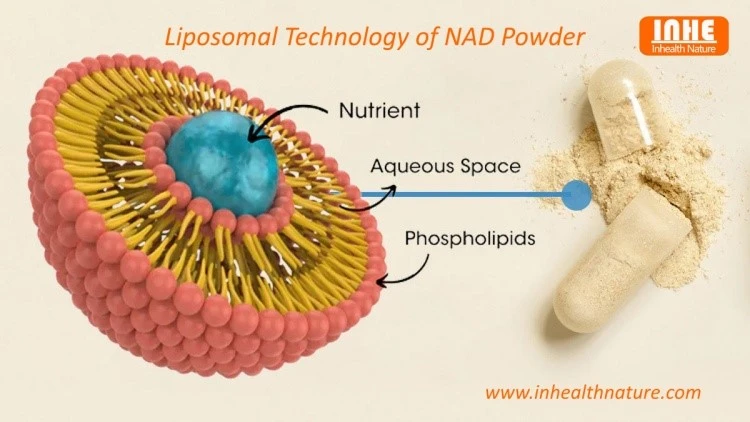
a. Definition: A formulation technique that encapsulates active ingredients within microscopic, spherical vesicles called liposomes.
b. Structure: Liposomes are composed of one or more phospholipid bilayers (similar to cell membranes), creating an inner aqueous core and a lipid-soluble outer layer.
c. Size range: Typically 50 nm to several micrometers in diameter; smaller liposomes (e.g., <200 nm) are preferred for supplement delivery.
d. Mechanism: The amphiphilic nature of phospholipids allows encapsulation of:
- Hydrophilic ingredients in the aqueous core.
- Lipophilic ingredients within the lipid bilayer.
Role of Liposomal Technology for Ingredients in Dietary Supplements
A. Enhanced Bioavailability
a. Overcomes poor absorption: Many supplement ingredients (e.g., curcumin, silymarin, coenzyme Q10) have low oral bioavailability due to poor solubility or rapid metabolism.
b. Protects from degradation: Liposomes shield ingredients from stomach acid, digestive enzymes, and first-pass liver metabolism.
c. Facilitates absorption: Lipids in liposomes promote uptake via intestinal lymphatic transport (bypassing the liver), increasing systemic circulation of intact ingredients.
B. Improved Cellular Uptake
a. Membrane fusion: Liposomes fuse with cell membranes, directly delivering encapsulated ingredients into the cytoplasm.
b. Endocytosis: Cells naturally take up liposomes via endocytic pathways, enhancing intracellular delivery.
c. Targeting potential: Surface modifications (e.g., ligands, PEGylation) can direct liposomes to specific tissues (e.g., liver, inflamed joints).
C. Protection of Sensitive Ingredients (Including Plant Extracts & Enzyme-Synthesized Compounds)
a. Plant extracts (e.g., green tea catechins, resveratrol, and quercetin):
- Prevent oxidative degradation before absorption.
- Reduce gastrointestinal irritation often caused by high doses of polyphenols.
b. Enzyme-catalyzed synthesis products (e.g., glucosides, specific esters, and prebiotic oligosaccharides):
- Stabilize enzymatically produced peptides, glycosides, or fatty acid esters against hydrolysis.
- Maintain activity of heat- or pH-sensitive enzyme-synthesized ingredients until they reach target sites.
D. Extended Circulation & Sustained Release
a. Prolonged half-life: Liposomes, especially coated with polyethylene glycol (PEG), avoid rapid clearance by the reticuloendothelial system (RES).
b. Controlled release: Gradual leakage or degradation of liposomes provides sustained ingredient levels, reducing dosing frequency.
E. Reduction of Toxicity & Side Effects
a. Masking unpleasant taste/smell: Beneficial for strong-tasting plant extracts (e.g., garlic, bitter melon).
b. Lower effective doses: Because absorption is higher, less total ingredient is needed, reducing potential liver/kidney overload or GI distress.
c. Decreased off-target effects: Encapsulation limits direct contact with gastric mucosa (e.g., for capsaicin or certain alkaloids).
F. Compatibility with Mixed Formulations
a. Co-encapsulation: Both hydrophilic (e.g., vitamin C) and lipophilic (e.g., vitamin E) ingredients can be carried together in one liposome.
b. Synergy potential: Allows simultaneous delivery of plant extract combinations (e.g., curcumin + piperine) or enzyme-synthesized cofactors in fixed ratios.
[Important Note]
It should be noted that the actual performance of oral liposomal supplements strongly depends on manufacturing parameters (e.g., encapsulation efficiency, phospholipid composition, particle size stability, and gastrointestinal robustness), and not all commercial products reliably achieve the above benefits.
Why is liposomal technology suitable for NAD+ Powder?
Liposomal technology serves as an advanced delivery system for NAD+ powder, designed to enhance its stability during digestion and improve its ability to enter cells, addressing the natural limitations of NAD+ in oral supplementation.
1. Protection through the gut: Stomach acid and digestive enzymes break down most free NAD+ before it can reach the bloodstream. Liposomes act as a physical barrier, wrapping around NAD+ molecules and shielding them until they reach the small intestine. This means far more NAD+ arrives intact and ready for absorption.
2. Efficient delivery into cells: Because NAD+ is charged, it cannot easily cross the lipid membrane of cells. Liposomes are made of similar lipid bilayers, so they fuse with cell membranes or get taken in via endocytosis. This directly delivers NAD+ into the cytoplasm, where it is needed. A study confirmed that liposomal formulation significantly increases intracellular NAD+ levels compared to free NAD+.
3. Measurable anti-aging effects: Better delivery leads to better results. The same study also showed that liposomal NAD+ reduced the number of senescent (aged) cells in both vascular and skin cell models, and lowered key aging markers like p16 and p21. Free NAD+ did not achieve this. For topical use, the liposomal version increased NAD+ penetration into skin by 30%.
4. Preserving energy metabolism: A 2002 study on stressed intestinal cells found that liposome-encapsulated NAD+ completely prevented the drop in cellular NAD+ levels and stopped the reduction in oxygen consumption. This kept mitochondrial function running normally.
5. Flexible delivery beyond just NAD+: Liposomes can carry more than one ingredient at a time. For example, researchers at Peking University developed an ultrasound-responsive liposomal platform that co-delivers NAD+ along with other molecules to both boost NAD+ and repair mitochondrial function for treating acute kidney injury.
What indicators should qualified liposomal ingredients meet?
Encapsulation Efficiency: >70%
A. What it reflects in the product: It means most of the active ingredient is actually inside the liposomes, not floating freely outside. High encapsulation efficiency translates directly to accurate dosing and better bioavailability, because only encapsulated ingredients are protected and effectively delivered into cells.
B. Issues if not met (<70%):
a. Lower than the labeled effective dose (some of what you take isn't protected).
b. Free ingredients get degraded in the gut before absorption.
c. Inconsistent results batch to batch.
d. Wasted money on a product that underdelivers.
Zeta Potential: Absolute value > 30 mV
A. What it reflects in the product: Zeta potential measures surface charge. Above |30| mV (positive or negative) means the liposomes strongly repel each other. This reflects good physical stability; they won't clump together or fuse over time.
B. Issues if not met (<|30| mV):
a. Liposomes aggregate and grow larger over time.
b. Short shelf life and visible sedimentation.
c. Inconsistent particle size and poor absorption due to aggregation.
d. The product becomes less effective before the expiration date.
Particle Size Control: Ideal 100-200 nm
A. What it reflects in the product: Particle size directly affects absorption. The 100-200 nm range is small enough to be taken up via endocytosis and to pass through biological barriers, but large enough to carry a meaningful load of active ingredient.
B. Issues if not met:
a. Too large (>300 nm): Poor cellular uptake; reduced ability to cross intestinal barriers or be taken up via endocytosis.
b. Too small (<50 nm): May leak active ingredients or lack sufficient loading capacity.
c. Inconsistent size means unpredictable absorption between doses.
Polydispersity Index (PDI): <0.3
A. What it reflects in the product: PDI tells you how uniform the particle sizes are. Less than 0.3 means a tight, homogeneous population. This reflects manufacturing precision and batch-to-batch consistency. Uniform particles behave predictably in the body.
B. Issues if not met (PDI ≥0.3):
a. Mixed sizes mean some particles absorb well, others poorly.
b. Unreliable performance from dose to dose.
c. Indicates poor manufacturing control.
d. Higher risk of aggregation (small particles stick to large ones).
Morphological Verification (TEM): Closed vesicular structure with "dark-light-dark" trilaminar membrane
A. What it reflects in the product: Transmission Electron Microscopy (TEM) visually confirms that you actually have liposomes, not something else (like micelles or lipid droplets). The "dark-light-dark" trilaminar pattern is the signature of a true bilayer vesicle. This reflects structural integrity and proper formation.
B. Issues if not met:
a. What you're taking may not be real liposomes; it could be cheap lipid mixtures or broken structures.
b. No bilayer means no protection, no fusion with cell membranes, and no enhanced delivery.
c. Product claims (e.g., "liposomal") are effectively false.
d. Complete loss of the benefits liposomal technology is supposed to provide.
What indicators should a qualified Liposomal NAD+ Powder meet?
High-quality liposomal NAD bulk powder must meet the following 5 critical indicators, which are more stringent than general liposomal ingredients due to NAD⁺'s inherent instability and poor bioavailability.
1. Encapsulation Efficiency: >80%
a. What it means: At least 80% of the NAD⁺ is successfully trapped inside liposomes.
b. Why this indicator: NAD⁺ is highly hydrophilic and degrades easily. Given its challenging nature, a stricter threshold of >80% ensures effective protection and delivery.
c. What it reflects: Superior loading capacity and efficient use of the active ingredient.
2. Zeta Potential: Absolute Value > 35 mV
a. What it means: The surface charge of liposomes must exceed +35 mV or -35 mV.
b. Why this indicator: A higher absolute zeta potential provides stronger electrostatic repulsion between liposomes, effectively preventing aggregation and ensuring long-term storage stability, particularly important for a sensitive molecule like NAD⁺.
c. What it reflects: Enhanced physical stability and extended shelf life for premium liposomal NAD⁺ formulations.
3. Particle Size Control: Ideal Range 120-150 nm
a. What it means: Individual liposome diameters must fall within 120-150 nm.
b. Why this indicator: This range is narrower than the general 100-200 nm benchmark. Particles below 120 nm may compromise loading capacity or increase leakage risk, while particles above 150 nm can reduce intestinal uptake efficiency and endocytosis.
c. What it reflects: An optimized balance between absorption efficiency, loading capacity, and formulation stability.
4. Particle Size Distribution (PDI): < 0.2
a. What it means: Particle sizes are highly uniform within a batch.
b. Why this indicator: Stricter than the general PDI < 0.3 requirement. NAD⁺ liposomes require more precise manufacturing to achieve consistent performance.
c. What it reflects: Exceptional batch-to-batch reproducibility and advanced process control.
5. Morphological Verification (TEM)
a. What it means: Under Transmission Electron Microscopy, particles must show a closed vesicular structure with the characteristic "dark-light-dark" trilaminar unit membrane.
b. Why this indicator: Confirms that the product is genuine liposomes, not broken fragments, aggregates, or other nanoparticle types.
c. What it reflects: True liposomal identity and structural integrity.
What other dietary supplement ingredients are suitable for use with liposomal technology?
Silybin
A. Botanical source: Milk thistle or Silybum marianum seeds; silybin is the most abundant and pharmacologically active flavonolignan in the silymarin complex.
B. Why liposomal technology is needed: Silymarin and silybin are lipophilic with low water solubility and undergo extensive first-pass liver metabolism, resulting in very poor oral bioavailability.
C. Key scientific findings:
a. A 2025 human clinical trial (double-blind, randomized, crossover, n=16) tested a micellar formulation vs. standard milk thistle at 130 mg silymarin. Results showed 18.9-fold higher Cmax and 11.4-fold higher AUC0-24 for the micellar formulation, plus faster absorption (Tmax 0.5h vs. 2.5h).
b. Phytosome technology (a liposomal-related system) has been shown to provide higher hepatoprotective efficacy and drug bioavailability for silybin.
Quercetin
A. Botanical source: Widely distributed in fruits, vegetables, and tea, such as onions, apples, grapes, etc, one of the most abundant dietary flavonoids.
B. Why liposomal technology is needed: Quercetin has low water solubility and poor oral absorption, limiting its therapeutic potential despite strong antioxidant and anticancer properties.
C. Key scientific findings:
a. Phytosome formulation of quercetin significantly increased apoptosis (programmed cell death) in cell models.
b. Liposomal encapsulation protects quercetin from degradation and enhances cellular uptake.
Curcumin
A. Botanical source: Rhizome of turmeric, a plant in the ginger family.
B. Why liposomal technology is needed: Curcumin is extremely hydrophobic, poorly absorbed, and rapidly metabolized. Its clinical use has been severely limited by these factors despite potent anti-inflammatory activities.
C. Key scientific findings:
a. Liposomal curcumin showed improved antioxidant and behavioral responses in inflamed mice.
b. A 2010 rat study showed liposomal curcumin (CL3 formulation, particle size 110-240nm, encapsulation efficiency 44-70%) achieved higher liver tissue concentrations compared to curcumin IV and oral solutions.
c. Deoxycholic acid-modified liposomal curcumin (Cur-DL) in a 2025 rat study achieved 5.78× higher AUC than curcumin suspension and 2.18× higher than non-modified liposomes. The formulation also showed only 15% release in simulated gastric fluid vs. 30.8% for standard liposomes.
Resveratrol
A. Botanical source: Found in Polygonum cuspidatum, red grape skins, berries, and peanuts.
B. Why liposomal technology is needed: Resveratrol has poor water solubility, rapid metabolism, and low oral bioavailability.
C. Key scientific findings:
a. Polygonum cuspidatum root extracts contain high levels of resveratrol and other polyphenols. Encapsulation in liposomes enhanced stability and modulated the delivery of these phenolic compounds.
b. Liposomal delivery improves the stability and bioavailability of resveratrol, protecting it from environmental degradation.
Naringenin
A. Botanical source: Predominantly found in citrus fruits, especially grapefruit; present as naringin (glycoside form), which converts to naringenin.
B. Why liposomal technology is needed: Naringin is a BCS Class IV compound with solubility of only ~38 μg/mL and less than 5% oral bioavailability.
C. Key scientific findings:
a. Phytosome formulation of naringenin provided sustained release and enhanced pulmonary bioavailability for acute lung injury treatment.
b. A 2025 comparative study on liposomal naringin formulations (spray-dried liposomal powder) showed:
- Liposomal encapsulation achieved 42.7% dissolution efficiency vs. only 5.6% for non-liposomal naringin powder.
- Dual encapsulation (liposomes inside microcapsules) slowed gastric release and maintained intestinal delivery, enabling sustained release profiles.
How should different groups of people choose between standard NAD+ Powder and Liposomal NAD+ Powder?
The choice is not about which is "better" overall. Both forms have their place. The right choice depends on the user's goals, budget, and specific absorption needs.
Standard NAD+ Powder: The Cost-Effective, Foundational Option
A. Best suited for:
a. First-time NAD users who want to test how their body responds before investing in advanced formulations.
b. Budget-conscious individuals who still want research-grade purity without premium pricing.
c. Younger adults (20s-30s) with generally healthy metabolism and no major absorption issues.
d. DIY formulators or supplement companies looking for a clean, unencapsulated raw material to blend into custom stacks or capsules.
e. Users who prefer high dosing flexibility (powder allows easy adjustment from 50 mg to 500 mg+ per serving).
B. Key characteristics:
a. Cost-effective: Lower price per gram compared to liposomal forms.
b. Research-grade purity: Typically ≥98-99% pure NAD+, suitable for clinical or lab use.
c. Transparent formulation: No additional phospholipids or encapsulation agents.
d. Predictable baseline absorption: Works well when taken sublingually or with absorption enhancers (e.g., piperine).
Liposomal NAD+ Powder: The Advanced Option for Maximum Absorption & Anti-Aging Efficacy
A. Best suited for:
a. Individuals with diagnosed or suspected absorption issues, including those with compromised gut health, leaky gut, or malabsorption syndromes.
b. Adults over 40-50 years old who experience natural declines in NAD+ levels and may have reduced digestive efficiency.
c. Users seeking measurable anti-aging effects (cellular repair, reduced senescence markers, and improved mitochondrial function) where higher intracellular NAD+ levels are critical.
d. People who have already tried standard NAD+ powder but felt little to no effect, the liposomal form addresses that specific "non-responder" scenario.
e. Athletes or biohackers looking for rapid and sustained NAD+ delivery without gastrointestinal side effects.
f. Formulators creating premium or targeted products (e.g., anti-aging capsules, topical serums, or high-end combination supplements).
B. Key characteristics:
a. Superior bioavailability: 5-10× higher cellular uptake compared to standard oral NAD+ (based on 2025 endothelial cell studies).
b. Gut-friendly: Liposomes protect NAD+ from stomach acid, reducing digestive irritation.
c. Extended release profile: Gradual delivery over hours rather than a sharp peak and rapid decline.
d. Verified quality specifications: High encapsulation efficiency (>80%), tight particle size control (120-150 nm), PDI <0.2, and TEM-confirmed bilayer structure.
Inhealth Nature's Dual Offering: Serving Diverse User Needs
Inhealth Nature provides both standard NAD+ powder and liposomal NAD+ powder, recognizing that no single format works for everyone. How this benefits different markets and users:
|
User / Market Segment |
Recommended Format |
Reason |
|
Budget-conscious first-time users |
Standard NAD+ powder |
Lower entry cost; allows self-assessment |
|
Supplement brands launching mass-market NAD products |
Standard NAD+ powder |
Cost-efficient ingredient for capsules or blends |
|
Premium anti-aging brands |
Liposomal NAD+ powder |
Justifies a higher price point with verified bioavailability |
|
Formulators targeting gut-compromised or elderly populations |
Liposomal NAD+ powder |
Solves absorption challenges directly |
|
Topical product developers (serums, creams) |
Liposomal NAD+ powder |
30% higher skin penetration was demonstrated in the 2025 study |
|
Research labs & clinical trials |
Both available |
Standard for baseline studies; liposomal for intervention arms |
Choosing the right NAD Powder format depends on your goals and target market. Standard powder offers cost-effective, research-grade purity for entry-level users. Liposomal powder delivers verified bioavailability for premium anti-aging applications. Both options are available to support diverse formulation needs. For partnership inquiries, sample requests, or technical specifications, contact kathy@inhealthnature.com. Let's build better NAD ingredient and formulation solutions together.