

How Does Hirudin Work in Human Body?
May 06, 2022
What is Hirudin Powder?
Hirudin Powder is a substance isolated from the salivary glands of Hirudo medicinalis (also known as “Shuizhi” in traditional Chinese medicine), which has blood anticoagulant property (i.e. prevents the formation of blood clots by slowing the blood clotting process). Hirudin inhibits thrombin, an enzyme that catalyzes the hydrolysis of fibrinogen into fibrin during blood coagulation. Hirudin consists of 64-66 amino acids and has a molecular weight of approximately 7000 Da. The chemical structure of natural hirudin is shown below.

When Discovered Hirudin?
★ Hirudin was first discovered in 1884, when Haycraft discovered that an extract of medicinal leech had anticoagulant property, which was later named hirudin by Jacoby in 1904.
★ In 1955, Mark Ward successfully obtained relatively pure hirudin extract from salivary glands, which has greatly facilitated the research on thrombin inhibitors.
★ The complete amino acid sequence of hirudin is first described by Dodt et al. In 1984.
★ Soon afterwards, several hirudin subtypes were discovered by Johnson et al. In 1989, such as hirudin variant 1 (hirudin-VV), hirudin variant 2 (hirudin-IT), and hirudin variant 3 (Hirudin-PA). They have highly similar core sequences and are highly specific thrombin inhibitors.
★ Since then, multiple variants of the three isoforms of hirudin have been described by Scharf et al. In 1989, and more than ten different hirudin variants (HVs) have been identified in leeches to date.
How Does Hirudin Work in Human Body?
★ Anti-thrombotic Effect
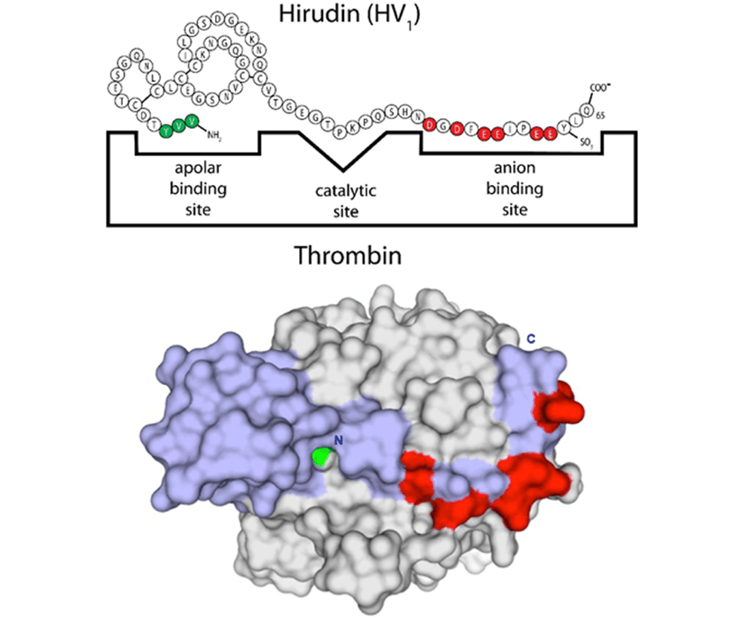
The highly specific inhibitory effect of hirudin on thrombin is closely associated with its chemical structure. Hirudin has been shown to have three pairs of disulfide bonds at the N-end (Cys6-Cys14, Cys16-Cys28, Cys32-Cys39), which form a compact structure that can bind to the active site of thrombin. In addition, the C-end is rich in acidic amino acid residues that can bind to the fibrinogen binding site of thrombin, thereby inhibiting the anticoagulant effect of thrombin . Additionally, a special sequence consisting of Pro-Lys-Pro was also described in the middle of the peptide chain, which not only maintains the stability of hirudin, but also guides the precise binding of hirudin to thrombin.
Unlike other anticoagulant drugs such as heparin and sodium citrate, hirudin inhibits the activity of thrombin in the absence of the cofactor antithrombin III (Dodt et al., 1985) and binds to thrombin in a 1:1 molar ratio.
★ Anti-tumor Effect
In recent years, several studies have confirmed the anti-tumor activity mediated by hirudin and revealed its mechanism of action to a certain extent. Hirudin has a broad anti-tumor spectrum and can be employed in treating different kinds of tumors, including glioma, hemangioma, nasopharyngeal carcinoma, hepatocellular carcinoma, and etc. Hirudin plays an anti-tumor effect by inhibiting the proliferation, migration and invasion of tumor cells, promoting apoptosis and regulating cell cycle. Potential mechanisms include down-regulation of ERK/MAPK, VEGF/VEGF-R and HGF/C-met signaling pathways, and decreased expression of angiogenesis-related factors focal adhesion kinase (FAK) and so on.
Any further information about our Hirudin Powder, please do not hesitate to contact kathy@inhealthnature.com.


