

Can High-Speed Countercurrent Chromatography Extract Xanthohumol?
Dec 17, 2024
can high-speed countercurrent chromatography extract xanthohumol?
Yes. Hops Xanthohumol Powder, a prenylated flavonoid found in hops, can be extracted using high-speed countercurrent chromatography (HSCCC). Compounds with low solubility or those sensitive to heat or solvents can be effectively separated and purified from complex mixtures using the HSCCC technique. Xanthohumol has a relatively low molecular weight and is soluble in nonpolar and moderately polar solvents. HSCCC uses a liquid-liquid partitioning process, which is well-suited for separating flavonoids and other natural products. Delicate compounds like xanthohumol can be separated using this method without the risk of degradation that sometimes occurs with more aggressive separation techniques like conventional column chromatography because it is gentle, solvent-efficient, and non-destructive. The key parameters in the extraction of xanthohumol using HSCCC would involve selecting an appropriate solvent system that optimizes the partitioning between the stationary and mobile phases and adjusting the flow rate and other operating conditions to achieve the best separation efficiency.

what is high-speed countercurrent chromatography?
High-Speed Countercurrent Chromatography (HSCCC) is a type of liquid-liquid chromatography technique that utilizes two immiscible liquid phases to separate compounds based on their partitioning behavior between the two phases. Unlike traditional solid-phase chromatography, where the stationary phase is typically solid (like silica gel), HSCCC uses two liquid phases, with one phase being the stationary phase (held in a column) and the other as the mobile phase (flowing through the system).
HSCCC is frequently used to separate complex mixtures, especially for pharmaceuticals, biomolecules, and natural products. Its benefits include high resolution, little product loss, and the ability to separate compounds that solid-phase chromatography techniques might find difficult.
How HSCCC Works
A. Two Liquid Phases
a. Stationary Phase: One of the liquid phases is stationary (non-moving) and is typically retained in the column due to gravity or centrifugal force.
b. Mobile Phase: The second liquid phase is mobile and continuously flows through the column, allowing the product to move and interact with the stationary phase.
B. Separation Principle (Partitioning)
a. The separation in HSCCC is based on the principle of partition chromatography. Compounds in the product partition between the two immiscible liquid phases. The compounds will distribute themselves between the stationary and mobile phases depending on their relative solubility (partition coefficient) in each phase.
b. A compound that is more soluble in the mobile phase will move faster through the column, while a compound more soluble in the stationary phase will interact more and travel more slowly.
C. Centrifugal Force
a. One of the key features of HSCCC is the use of centrifugal force (in the HSCCC instrument) to keep the immiscible liquid phases from mixing. This is typically achieved by spinning the column at high speeds, which generates centrifugal forces that help maintain the liquid-liquid phase system.
b. This centrifugal force also plays a critical role in forcing the mobile phase through the stationary phase, allowing for the separation of compounds based on their partition coefficients.
D. Gradient Elution
a. Just like in traditional chromatography, HSCCC can employ gradient elution, where the composition of the mobile phase changes over time. This is useful when dealing with products that contain a broad range of polarities, as the mobile phase's composition can be adjusted to optimize the separation.
E. Detection
a. After the separation is complete, the individual components can be collected from different outlets of the HSCCC system. Various detectors can be used to monitor the separated compounds, such as UV-Vis absorbance detectors, fluorescence detectors, or mass spectrometry.
Key Components of HSCCC
A. HSCCC Instrument:
This typically consists of:
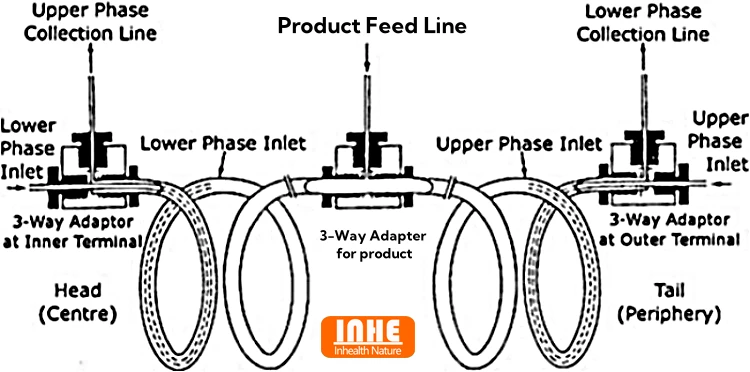
a. Rotating Column: A cylindrical column that is spun at high speeds. It is filled with one of the immiscible liquid phases.
b. Liquid Reservoirs: These hold the two immiscible liquid phases that are pumped into the system.
c. Product Injection System: This is where the product is introduced into the chromatography system.
d. Elution System: The system that pumps the mobile phase through the rotating column.
e. Fraction Collector: This collects the separated components after they exit the column.
B. Phase System: The two immiscible liquid phases used in HSCCC must be carefully selected. These could include:
a. Aqueous-organic mixtures: Commonly used solvent systems like water-organic solvent mixtures, for example, water-ethyl acetate.
b. Two organic solvents: In some cases, two immiscible organic solvents can be used.
Advantages of HSCCC
A. No Solid Stationary Phase
HSCCC does not rely on solid stationary phases like silica gel, which means there is no risk of irreversible adsorption or product degradation due to interactions with the stationary phase.
B. High Resolution
The separation efficiency is generally high, which is especially beneficial for purifying natural products or other complex mixtures where components have very similar properties.
C. Non-destructive
As HSCCC involves liquid-liquid interactions, it often results in a more gentle separation process, minimizing degradation or loss of sensitive compounds.
D. Minimal Product Loss
Since the process uses only liquid phases, the product loss is typically much lower compared to traditional chromatographic techniques.
E. Versatile
It can be applied to a wide range of substances, including pharmaceuticals, biomolecules, and natural products with a variety of polarities.
Applications
HSCCC is widely used in pharmacology, chemistry, biotechnology, and natural product isolation. Specific applications include:
a. Purification of Natural Products: For isolating bioactive compounds from plant extracts, marine organisms, or fermentation broths.
b. Isolation of Pharmaceutical Compounds: For separating and purifying drug molecules from complex mixtures.
c. Purification of Biomolecules: Such as proteins, nucleic acids, and peptides.
d. Enantioseparation: To separate chiral compounds, which is important in the pharmaceutical industry to produce optically pure drugs.
what plant extracts can be extracted by HSCCC?
Several plant extracts have been successfully processed using HSCCC to isolate a wide range of bioactive compounds. Below are some specific plant-derived products that have been isolated by this method:
★ Flavonoids
a. Rutin from Ruta graveolens (Rue)
b. Quercetin from Hibiscus rosa-sinensis and Allium cepa (onion)
c. Luteolin from Chamomilla recutita (chamomile)
★ Alkaloids
a. Berberine from Berberis vulgaris (Barberry)
b. Sparteine from Cytisus scoparius (Scotch broom)
c. Corydine from Corydalis species
★ Terpenoids and Essential Oils
a. β-Caryophyllene from Cinnamomum verum (Cinnamon)
b. Artemisinin from Artemisia annua (Sweet Wormwood)
c. Triterpenes from Ganoderma lucidum (Reishi mushroom)
d. Limonene from Citrus sinensis (Orange peel)
★ Phenolic Acids
a. Caffeic acid from Echinacea purpurea
b. Chlorogenic acid from Coffea arabica (Coffee)
c. Gallic acid from Camellia sinensis (Tea)
d. Rosmarinic acid from Rosmarinus officinalis (Rosemary)
★ Glycosides
a. Anthraquinone glycosides from Rheum palmatum (Rhubarb)
b. Saponins from Glycyrrhiza glabra (Licorice)
c. Ginsenosides from Panax ginseng (Ginseng)
d. Geniposide from Gardenia jasminoides
★ Flavonoid Glycosides
a. Isoquercitrin from Cucumis sativus (Cucumber)
b. Hyperoside from Hypericum perforatum (St. John's Wort)
★ Coumarins
a. Scopoletin from Scopolia japonica
b. Umbelliferone from Coriandrum sativum (Coriander)
★ Steroids
a. β-Sitosterol from Pygeum africanum (African plum tree)
b. Stigmasterol from Glycine max (Soybean)
c. Campesterol from Brassica oleracea (Cabbage)
★ Polysaccharides
a. Ganoderan from Ganoderma lucidum (Reishi mushroom)
b. Chitosan from Mushrooms (particularly Criniella species)
★ Amino Acids and Peptides
a. Aminopeptidase inhibitors from Pisum sativum (Peas)
b. Glutathione from Spinacia oleracea (Spinach)
where to buy xanthohumol?
Inhealth Nature's commitment to more than ten years in ingredient R&D shines through its premium product, Hops Xanthohumol Powder. This product, meticulously developed and produced, embodies Inhealth Nature's engagement with quality and efficacy. The overwhelmingly positive customer feedback is a piece of evidence of Xanthohumol's excellent performance. By selecting Inhealth Nature's Xanthohumol, you're selecting a dependable partner with a track record of excellence, not just a raw ingredient.
Welcome to contact us at bella@inhealthnature.com if you have any inquiries or questions.


