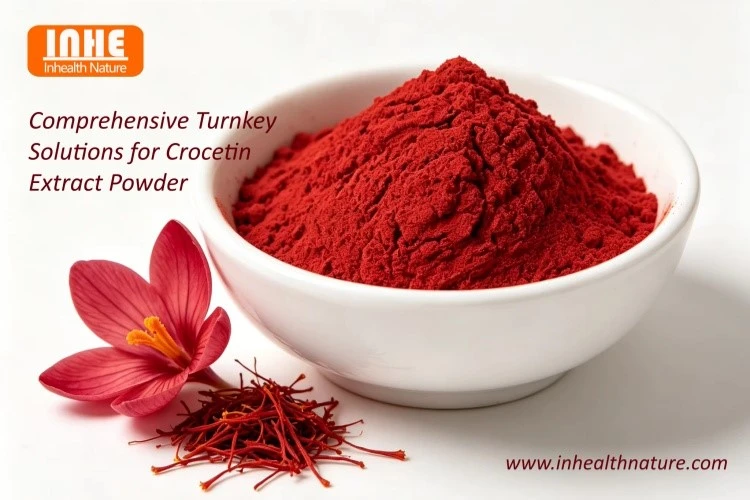
Comprehensive Turnkey Solutions for Crocetin Extract Powder
Sep 03, 2026
For formulators, R&D directors, and production managers in dietary supplements, nutraceuticals, functional foods, beverages, and cosmetics, Crocetin Powder offers significant product differentiation-but only if formulation challenges are properly addressed. This guide provides a comprehensive overview of crocetin extract powder applications across three key sectors, along with the turnkey solutions that simplify development and scale-up.
Dietary supplements & nutraceuticals: common dosage forms, challenges, and solutions
|
Dosage Form |
Challenges |
Solutions |
|
Hard Capsules |
1. Poor powder flow due to electrostatic adhesion leads to inconsistent fill weights; |
1. Flowability improvement: Particle size control through 80-mesh screening ensures consistent flow properties; |
|
Softgels |
1. Crocetin's lipophilic nature requires appropriate oil-based carriers; |
1. Incorporate crocetin into lipid-based carriers with natural antioxidants; |
|
Tablets |
1. Poor compressibility without appropriate excipients; |
1. Wet granulation with microcrystalline cellulose or mannitol to improve compressibility; |
|
Stick Packs (Powdered Sachets) |
1. Hygroscopicity affecting flowability; |
1. Select appropriate carrier systems with low hygroscopicity (e.g., maltodextrin, isomaltulose) for improved flow; 2. Use cyclodextrin inclusion complexes to improve water dispersibility; 3. Maintain particle size distribution within the 80-120 mesh range to reduce dusting and static adhesion |
Functional foods &beverages: common categories, challenges, and solutions
|
Category |
Challenges |
Solutions |
|
RTD Shots (Ready-to-Drink) |
1. Crocetin's poor water solubility leads to sedimentation or haze; |
1. Use HP-β-CD inclusion complexes to achieve water-soluble crocetin forms (inclusion complexes have been shown to improve crocetin bioavailability by 3-4 fold); |
|
Powdered Mixes |
1. Uniform dispersibility in aqueous media; |
1. Use spray-dried microencapsulated crocetin for instant dispersibility; |
|
Protein Bars |
1. Heat and shear sensitivity during bar processing; |
1. (e.g., controlled temperature mixing and low-shear extrusion) to minimize heat and mechanical stress; |
|
Fortified Yogurts and Dairy Products |
1. Protein-crocetin interactions affecting stability; |
1. Pre-disperse crocetin in a small portion of the dairy base under moderate shear, followed by gradual incorporation into the bulk - this sequential mixing approach minimizes localized protein-crocetin interactions and ensures uniform distribution; |
|
Meal-Replacement Sachets |
1. Complex ingredient matrices with potential interactions; |
1. Two-phase formulation design: crocetin in a lipid phase, water-soluble components in a hydrophilic matrix; 3. Nitrogen-purged packaging with high-barrier materials (low OTR and WVTR) to minimize oxidative and moisture degradation |
Cosmetics: common categories, challenges, and solutions
|
Category |
Challenges |
Solutions |
|
Lightweight Serums |
1. Crocetin's lipophilic nature requires appropriate solubilization; |
1. Utilize liposomal encapsulation or cyclodextrin inclusion complexes to achieve stable solubilization in aqueous serum bases; |
|
Daily Moisturizers |
1. Crocetin's red-orange color may affect final product appearance; |
1. Use low concentrations (0.01-0.1%) to achieve efficacy; incorporate into the oil phase of emulsions; color impact can be further minimized through microencapsulation or cyclodextrin inclusion; |
|
Night Creams |
1. Stability during prolonged storage; |
1. Lipid-based carriers with natural antioxidants; |
|
Sheet Masks |
1. Uniform distribution on the mask substrate; |
1. Select mask substrates with high retention capacity to ensure uniform serum loading; use standardized application procedures (e.g., controlled serum loading volume per mask, uniform soaking time) to ensure consistent distribution; 2. Water-soluble inclusion complexes for serum formulations 3. Use low concentrations (within the 0.01-0.1% range) and inclusion complexation to keep color impact minimal on the final product |
|
Eye Contour Gels |
1. pH sensitivity around the delicate eye area; |
1. Precisely pH-adjusted formulations (5.5-6.5) for ocular tolerance; |
inhealth nature turnkey solutions
Inhealth Nature provides comprehensive turnkey solutions addressing the formulation challenges across the food, pharmaceutical, and cosmetic sectors:
What We Offer
|
Service Category |
Description |
|
Raw Material Customization |
Crocetin Extract Powder available in purity grades: 5%, 10%, 50%, 95% (HPLC-verified) |
|
Solubility Enhancement |
HP-β-CD inclusion complexes and ternary solid dispersion formulations |
|
Pre-formulation Support |
Compatibility studies, stability protocols, and dosage form optimization |
|
Technical Documentation |
COA, TDS, MSDS, cGMP, Halal, Kosher, FSSC22000, ISO22000, and SC |
|
Custom Formulation Development |
Tailored solutions for capsules, tablets, softgels, beverages, cosmetics, and more |
|
Regulatory Support |
Third-party test reports (SGS, Eurofins) and regulatory documentation. Crocetin is recognized by WHO/JECFA as a food ingredient rather than a food additive, which may simplify regulatory pathways for functional food applications |
|
Scale-up Assistance |
From lab-scale to commercial production with consistent quality |
Key Capabilities
a. Purity verification: HPLC assay with typical results reaching 98.25% for a 95% specification
b. Particle size control: 98% through 80 mesh standard specification
c. Heavy metal compliance: As ≤3 ppm, Pb ≤10 ppm
d. Microbiological control: Total plate count ≤1000 cfu/g; yeasts/molds ≤100 cfu/g; E. coli and Salmonella negative
e. Shelf life: 24 months when properly stored
Inhealth Nature turnkey service process
For clients interested in partnering with Inhealth Nature, our turnkey service workflow is structured as follows:
Phase 1: Discovery & Assessment
a. Ingredient specification review
b. Stability and compatibility pre-screening
c. Initial formulation feasibility study
d. Regulatory pathway identification
Phase 2: Formulation Development
a. Prototype development based on target dosage form
b. Optimization of carrier systems and excipients
c. In vitro dissolution and stability evaluation
d. Sensory optimization (taste, color, odor)
Phase 3: Scale-Up & Commercialization
a. Pilot-scale trials with process validation
b. Production scale-up support
c. Quality control protocol establishment
d. Regulatory documentation and compliance
Phase 4: Supply Chain & Logistics
a. Flexible packaging options: 1g/bottle, 1kg/bag, 25kg/drum
b. Air freight, sea freight, or express courier, based on order quantity
c. Inventory management and just-in-time delivery
Phase 5: Post-Launch Support
a. Ongoing stability monitoring
b. Formulation refinement based on market feedback
c. New product development support
Common misconceptions and realities
Misconception #1: All Crocetin Extract Powder is the Same
Reality: Crocetin Extract Powder purity grades vary significantly-from 5% to 95%-with distinct applications.
1) Lower purities (5-10%) offer the optimal balance of functionality and dispersibility for beverages and functional foods
2) Mid-range (50-75%) provides the best balance of active content and formulation flexibility for capsules and tablets
3) High purities (95% and above) are preferred for premium applications and advanced delivery systems requiring maximum potency
The highest purity is not always the choice-purity selection should align with the target dosage form, cost targets, and performance requirements.
Misconception #2: Crocetin Cannot Be Used in Water-Based Products
Reality: Crocetin is naturally poorly water-soluble, but advanced formulation technologies-such as cyclodextrin inclusion complexes, ternary solid dispersions, and liencapsulation-make aqueous applications entirely feasible. Peer-reviewed studies have documented that inclusion complexes, in particular, can achieve substantial increases in its water solubility.
Misconception #3: Crocetin is Unstable in Most Formulations
Reality: Crocetin exhibits good stability across a broad pH range (approximately 4.0-7.0) with proper formulation design. With appropriate antioxidants, chelating agents, and protective packaging, crocetin maintains stability throughout its 24-month shelf life.
Misconception #4: Natural Saffron Extract and Crocetin Extract Powder Are Interchangeable
Reality: While crocetin is a constituent of saffron, they are not interchangeable ingredients. Natural saffron extract is a complex mixture containing compounds-including crocin, picrocrocin, and safranal-with crocetin present only in trace amounts (typically <2%). Crocetin Extract Powder, whether derived from saffron or produced via other routes, is a purified, standardized active ingredient with defined purity grades (5-95%) and consistent potency. For formulators, this distinction matters: saffron extract delivers the sensory and bioactive profile of the whole botanical source, whereas crocetin extract powder provides precise, reproducible dosing of a single molecular entity with known pharmacokinetics and biological activity. Choosing between them depends on whether the product aims for the full-spectrum saffron experience or a standardized, potency-driven formulation.
Misconception #5: OEM and Turnkey Solutions Are the Same Thing
Reality: They differ fundamentally in scope and service. Under an OEM model, the client provides a fully developed formula and assumes responsibility for stability, scalability, and regulatory compliance. A turnkey solution, by contrast, is a more integrated partnership: Inhealth Nature can support your project from formulation development and process validation through to regulatory documentation and finished product delivery. We bring formulation science, manufacturing infrastructure, and quality systems-helping compress development timelines and reduce the need for in-house R&D investment. Clients retain final approval on formulation choices and remain responsible for market compliance, while we manage the technical execution. In short: OEM executes your formula; turnkey accelerates your product from concept to commercialization, with shared accountability along the way.
Why choose inhealth nature?
At Inhealth Nature, we combine scientific rigor with commercial practicality. Our team provides comprehensive support for Crocetin Powder formulators, from purity selection and pre-formulation studies to scale-up and commercial production. Our turnkey solutions are backed by robust quality systems (cGMP, FSSC22000, ISO22000, Kosher, Halal) and third-party test reports (SGS, Eurofins). Ready to bring your crocetin extract powder product to market?
Contact our formulation specialists at bella@inhealthnature.com today to discuss your requirements-whether you need an ingredient supply or a complete turnkey formulation solution.
References
1. Tong Z, Liu X, Tao Y, et al. Enhancement of dissolution and oral bioavailability by adjusting microenvironment pH in crocetin ternary solid dispersions: Optimization, characterization, in vitro evaluation, and pharmacokinetics. Drug Delivery and Translational Research. 2024;14(7):1923-1939. (Rodent pharmacokinetic data)
2. Method for the purification of crocetin. WO2004078695A1.
3. Saffron formulations and product patents. In: Saffron: Science, Technology and Health. 2020:493-515.
4. Liu N, Xiao J, Zang LH, Quan P, Liu DC. Preparation of trans-Crocetin with High Solubility, Stability, and Oral Bioavailability by Incorporation into Three Types of Cyclodextrins. Pharmaceutics. 2023;15(12):2790. DOI: 10.3390/pharmaceutics15122790